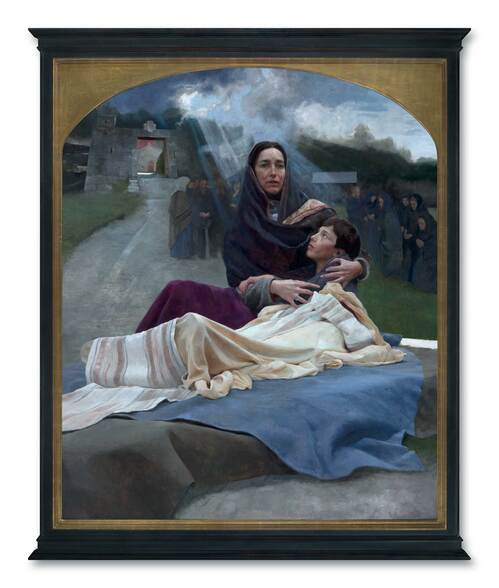
Widow of Nain, Morgan Irons
Morgan Irons
American, born USA, 1991 - present
Oil on Panel
72 x 60 inches
Widow of Nain, 2025
This painting captures one of the most profound moments of compassion in the Gospels, found only in Luke 7:11-17. As Jesus approached the town of Nain, he encountered a funeral procession carrying a young man to his burial. But this story belongs first to his mother, a widow burying her only son.
Her grief was compounded by catastrophic loss. In the ancient world, a widow without sons faced not only the devastating loss of her child but also economic ruin and social vulnerability.
Luke tells us that when Jesus saw her, his heart went out to her. Before anyone asked, before any plea for help, Jesus was moved by her suffering. He approached and spoke directly to her: "Don't cry." Then, defying religious law that forbade touching the dead, he stopped the funeral bier and commanded the young man to rise.
The son sat up, alive and speaking. But notice Luke's careful phrasing, Jesus "gave him back to his mother." This wasn't a spectacle or mere demonstration of divine power. It was an act of restoration, of seeing a woman in crisis and returning to her both her son and her future. Jesus centered her experience, her loss, her need.
This story reminds us that sacred attention often falls on those the world overlooks. It speaks to every person who has experienced loss that feels like an ending, who has faced a future that seems impossible to bear.
In painting this scene, I wanted to honor the widow's central place in this narrative. Her experience of devastating loss, her moment of encountering unexpected compassion, her restoration to hope, these form the heart of the story. Before the miracle, before the crowd's amazement, there was simply a mother's grief met with divine tenderness.
Unveiled December 2025 during an event at Armature Works in Tampa, FL.
Connect with Morgan Irons
American, born USA, 1991 - present
Oil on Panel
72 x 60 inches
Widow of Nain, 2025
This painting captures one of the most profound moments of compassion in the Gospels, found only in Luke 7:11-17. As Jesus approached the town of Nain, he encountered a funeral procession carrying a young man to his burial. But this story belongs first to his mother, a widow burying her only son.
Her grief was compounded by catastrophic loss. In the ancient world, a widow without sons faced not only the devastating loss of her child but also economic ruin and social vulnerability.
Luke tells us that when Jesus saw her, his heart went out to her. Before anyone asked, before any plea for help, Jesus was moved by her suffering. He approached and spoke directly to her: "Don't cry." Then, defying religious law that forbade touching the dead, he stopped the funeral bier and commanded the young man to rise.
The son sat up, alive and speaking. But notice Luke's careful phrasing, Jesus "gave him back to his mother." This wasn't a spectacle or mere demonstration of divine power. It was an act of restoration, of seeing a woman in crisis and returning to her both her son and her future. Jesus centered her experience, her loss, her need.
This story reminds us that sacred attention often falls on those the world overlooks. It speaks to every person who has experienced loss that feels like an ending, who has faced a future that seems impossible to bear.
In painting this scene, I wanted to honor the widow's central place in this narrative. Her experience of devastating loss, her moment of encountering unexpected compassion, her restoration to hope, these form the heart of the story. Before the miracle, before the crowd's amazement, there was simply a mother's grief met with divine tenderness.
Unveiled December 2025 during an event at Armature Works in Tampa, FL.
Connect with Morgan Irons
Widow of Nain | 2025